Choosing a local print shop is less about browsing categories and more about aligning your exact deliverable with the shop’s documented capabilities. Reprocraft, a specialty printing company in Buffalo, pairs commercial print services with large-format production and document-focused workflows. If you’re comparing options for banners, signs, blueprints, scanning, or document retention, this guide outlines the questions that prevent reprints and delays—and shows what to verify when you reach out.
Start with the deliverable: size, media, and the “finished” version
Reprocraft highlights large-format digital printing for items such as banners, signs, and architectural drawings, with printed width limits stated on its website. Before requesting a quote, translate your project into concrete production constraints: final dimensions, color mode needs, and the type of surface you want (for example, bond, mylar, vellum, or vinyl are mentioned as supported media categories). Ask the shop to confirm whether your file setup matches the intended output—especially if your artwork includes spot colors, fine text, or architectural linework.
If your project includes mounting or lamination, treat those as part of the deliverable—not an afterthought. Reprocraft’s site lists large-format lamination and mounting services (including glossy and matte options) and describes ways prints can be protected through lamination. For the smoothest ordering process, request a single, written scope that ties together printing + finishing, so you know what “finished” means when proof approval happens.
Confirm proofing and revision behavior before you approve the job
Even when a print shop is experienced, the costliest mistakes are usually approval-related: approving the wrong version, approving a file with missing fonts, or misunderstanding how changes are tracked. Ask Reprocraft (and any competitor you’re comparing) to explain what proof approval means in practice. For example, confirm whether they provide a proof only for layout and content, or whether you should review color expectations for your specific media.
Also ask for clarity on the change process: when you request revisions after proof approval, what happens to the timeline? This matters because Reprocraft positions itself for fast turnaround, and it also lists multiple specialty services (scanning, archiving, mounting/lamination, and more). Your job may be “quick-turn” only if the revised files arrive in the correct format and the finishing requirements stay the same.
Match your input files to what they can reproduce and scan
Reprocraft lists scanning and archiving services, including the ability to create high-quality digital files in PDF, TIFF, or JPEG formats. If your goal is document management, don’t just ask whether they “scan”—ask how they organize the outputs, what resolution or image quality targets they recommend for your originals, and which output format best fits downstream use (sharing, printing, OCR workflows, or long-term archiving).
For print jobs, confirm the shop’s intake path for both digital files and hard-copy originals. On the Reprocraft website, they mention secure file transfer for submitting print requests, and they advise including job details such as job name, black-and-white or color printing, print size, media type, quantity, and binding/finishing options. That list is a helpful template for your submission, because it pushes the conversation toward the specifics that prevent back-and-forth later.
Decide if you need document management or simple reproduction
Some projects are straightforward reproduction; others are a documentation workflow. Reprocraft’s site describes document management and distribution, emphasizing that project information is kept private and that they coordinate incoming information from multiple sources. If your request involves controlled handling (for example, ongoing office document cycles or coordinated bid packages), bring that into the conversation early. Ask what “file retention” means for your project and how your materials are handled end-to-end.
For team workflows, this is also where you should discuss delivery expectations and what they can support for archiving your final deliverables. Even if two shops both print large format, the one that clearly explains scanning, archiving formats, and document distribution may reduce administrative work after the print is delivered.
Contact and on-ramp details to use when you request a quote
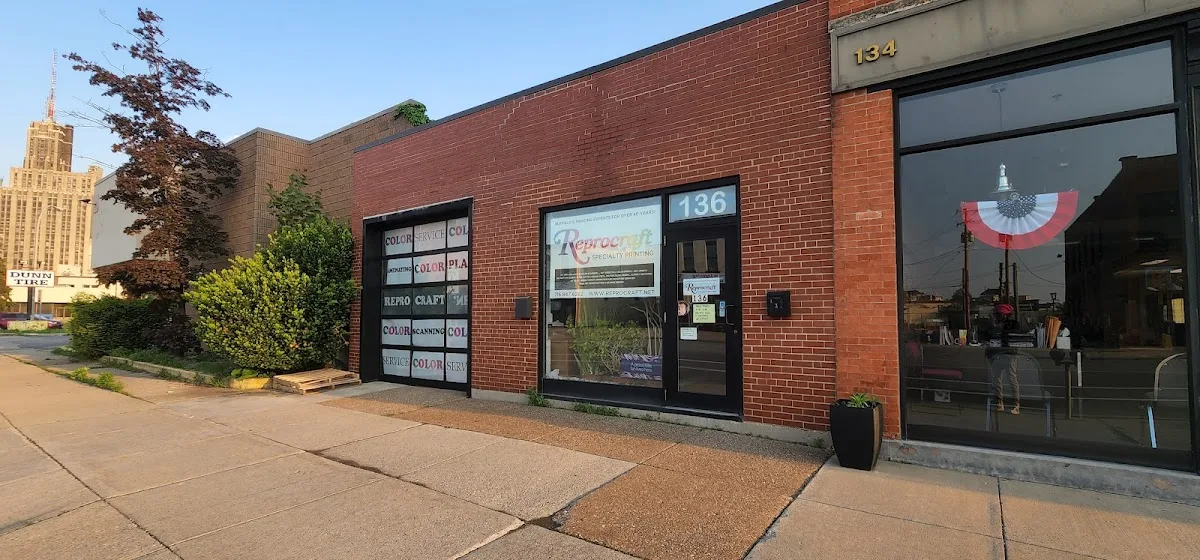
If you’re ready to compare Reprocraft against other local printers, start with the basics they publish: visit their website at http://www.reprocraft.net/ or call +1 716-847-6262. Reprocraft also lists its shop address as 136 Broadway, Suite 102, Buffalo, NY 14203, which can be useful for verifying travel time and pickup logistics.
Before you place an order, send a message that includes your exact dimensions, target media type, quantity, and the finishing you want (such as mounting or lamination). If your job mixes printing with scanning or archiving, spell out both deliverables in the same request. That alignment is what turns a “print inquiry” into a precise scope—and it’s often the difference between a smooth proof-to-production process and an avoidable rework.