Ordering business cards, posters, signs, or banners is less about finding a “print shop” and more about matching your project risk to a provider’s workflow. If you’re looking at Staples in Albany, NY, the fastest way to decide is to verify how their print and marketing services handle three pressure points: proof approval, file fit, and finishing.
Here are practical, non-hand-wavy questions you can use before you place an order—so you don’t discover layout or trim problems after the print run. This is especially important if your design has brand-critical colors, tight typography, or content that must land exactly within the final dimensions.
Start with the scope Staples publicly supports (and what you should confirm)
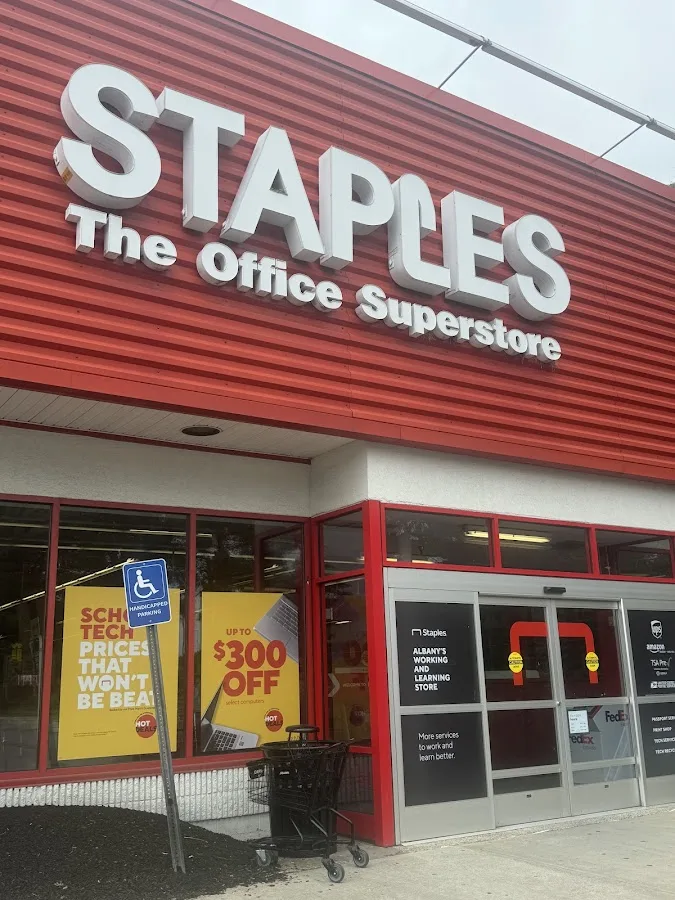
Staples is listed as a Graphic Design & Print Studio at 1440 Central Ave, Albany, NY 12205, United States, and the store’s print offering is presented under its “Print and Marketing Services” page. Before you upload artwork or place a reorder, confirm that your exact deliverables are within scope—because public listings can’t guarantee every format, substrate, or finishing option is available for every job.
Two questions that usually uncover the most risk:
- “Which specific product types do you build from customer files?” (Business cards vs. posters vs. banners can require different setup.)
- “What’s the accepted artwork path?” Ask whether they prefer PDF/X exports, editable source files, or templated uploads for each item type.
Proof approval: what you’re signing off on
Many reprint issues start at the approval stage. When a store provides a proof, ask what that proof represents.
Verify proof = production, not just “a visual preview.”
Use plain language: “Does the proof match the final trim size, bleed/crop behavior, and color handling?” If you’re approving a document that doesn’t reflect final margins or finishing, you may approve something that looks fine on screen but ends up cropped or off-register in the real output.
If Staples serves multiple print channels, it’s also reasonable to ask whether your proof is generated from the same files that will go into production. If they can’t answer clearly, request the exact details of what changes between proof and final run.
File fit for print: dimensions, bleed, and typography
Even when two files look visually identical, small setup differences can break print layouts. For example, text alignment can shift if the layout uses different crop settings than the production template.
Confirm bleed and crop settings for every format
Before submission, ask: “Is your template asking for bleed, and what bleed value should I use for this size?” Also ask how they want your artwork positioned relative to trim. If your design includes borders or full-bleed backgrounds, clarify whether they will extend or require you to extend the artwork for safe cropping.
Fonts and color-critical elements
For logo work and brand-critical flyers, typography issues are common. Request confirmation on whether they support embedded fonts in your PDF and whether they recommend outlining or converting text. Then ask about color expectations: “If my brand uses specific colors, how do you handle color matching or proofing adjustments?”
Staples’ store listing includes a contact phone, +1 518-435-9920, so you can use a quick call to confirm these file-readiness requirements before uploading.
Finishing that affects readability (and how to prevent surprises)
Finishing is where many “almost right” prints become visibly wrong. The right paper choice, lamination, or coating can change contrast, readability, and how colors appear.
Ask how finishing impacts the final appearance
When you’re ordering marketing pieces or signs, ask whether finishing changes:
- Brightness and contrast (especially for light text on colored backgrounds)
- Gloss level (which can affect glare in real-world lighting)
- Edge clarity (relevant for borders, cutouts, and thin lines)
If your project will be photographed for online posts or presented in a specific setting, ask for guidance on the finishing look that matches that use case. It’s a simple way to reduce “it looked different in person” problems.
Decision test: does Staples feel like a workflow match for your deadline?
Staples can be a practical option when you want a store location in Albany and a clear place to ask about print and marketing services. But the real decision comes from how quickly they can answer the proof, file-fit, and finishing questions above—because those answers tell you whether your job risk is understood.
If you can’t get straight answers, treat it as a flag: either your files need more preparation, or your project type needs a different production workflow. Either way, asking these questions first usually costs less than correcting a reprint.